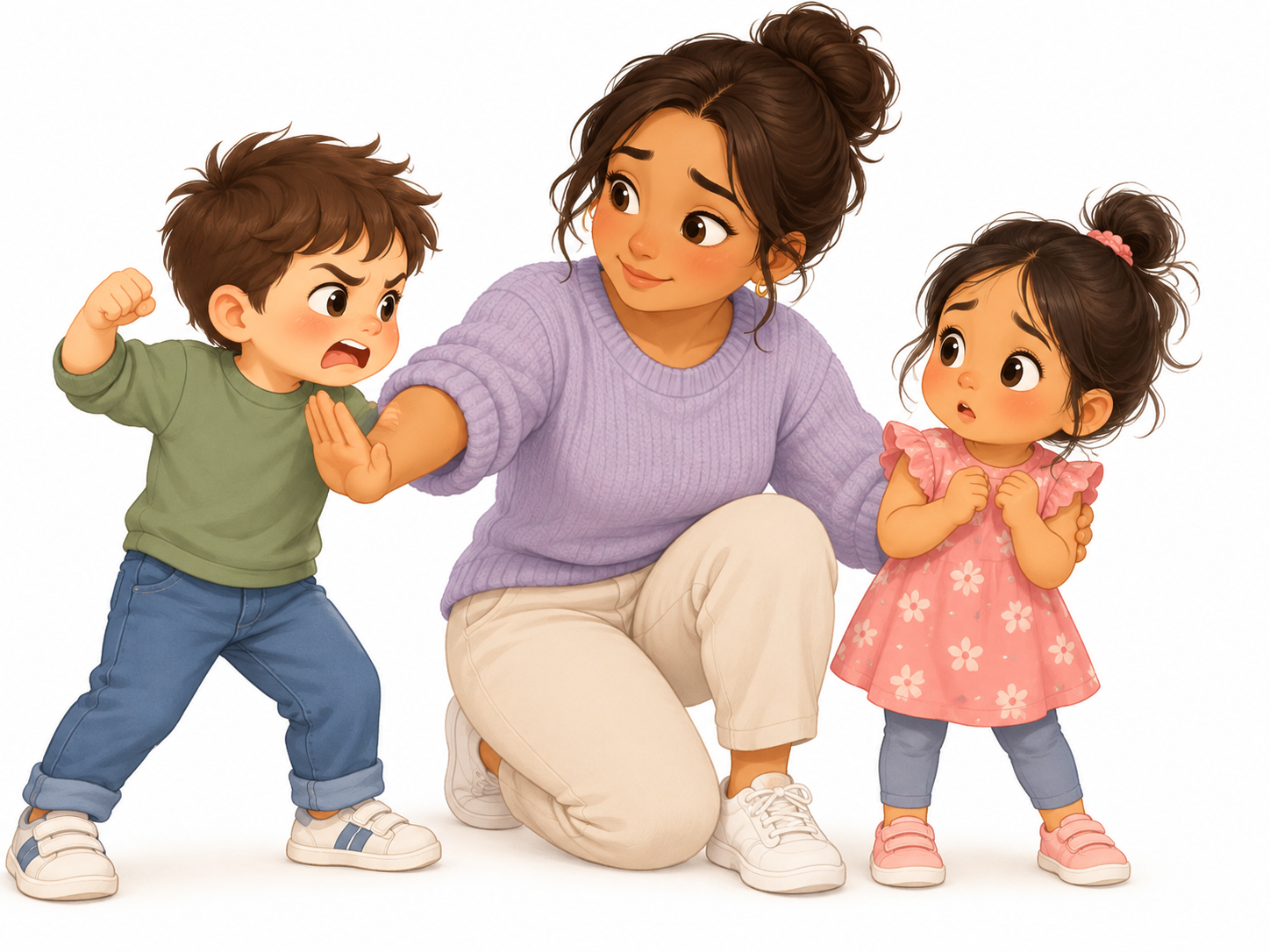
Few behaviors get a parent’s attention as quickly as hitting, biting, kicking, or pushing. Whether it happens at home, on the playground, or at preschool, it can feel embarrassing, upsetting, and sometimes alarming.
For young children, physical aggression does not automatically mean they are becoming an “aggressive child.” Toddlers and preschoolers are still developing impulse control, language, perspective-taking, and the ability to manage strong emotions. Sometimes the body reacts before the child has the words or self-control to do something different.
That does not mean hitting should be ignored. Children need a clear boundary; but they also need help learning what to do instead.
Start with safety, not a lecture
In the moment, the first priority is simple: stop the behavior and keep everyone safe.
Move close, gently block the hit if possible, separate the children when needed, and use a short statement:
“I won’t let you hit.”
“Biting hurts. I’m going to help you stop.”
When a child is already highly upset, a long explanation usually isn’t very useful. The brain is busy managing the emotion itself. Save most of the teaching for later, when the child is calmer.
A firm boundary can still be calm. The goal is not to scare the child into stopping; it is to make the limit predictable.
Help before asking for an apology
Adults often immediately say, “Say sorry.”
But a forced apology does not necessarily teach empathy, especially if the child is still angry.
First, help everyone settle. Check on the child who was hurt. Then, when the situation is calmer, help the child who hit understand what happened:
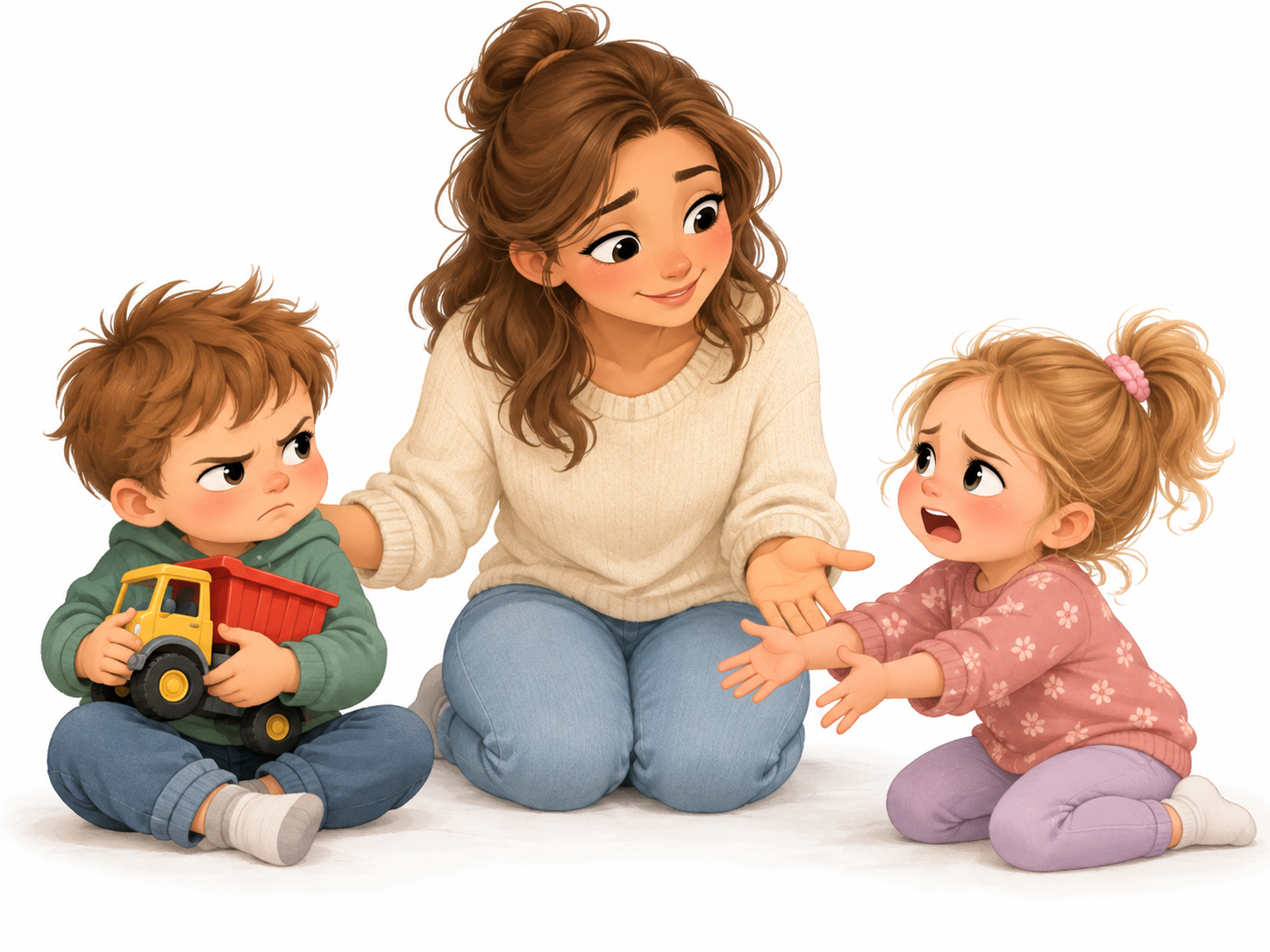
“You were angry because he took the truck. You hit him. Hitting hurts.”
Then move toward repair:
“Let’s see if he’s okay.”
“Would you like to bring her an ice pack?”
“We can help rebuild the blocks.”
A genuine apology may come later. Learning how to repair a situation is often more meaningful than simply repeating the word sorry.
Teach the replacement behavior when everyone is calm
Telling a child “Don’t hit” explains what they cannot do. They also need to learn what they can do when the same problem happens again.
Practice simple alternatives:
“Stop!”
“My turn.”
“I don’t like that.”
“Help me.”
For younger toddlers, words may still be difficult in emotional moments. Adults can model the words repeatedly and step in earlier when they see a conflict beginning.
Role-play can work well too. Use stuffed animals:
“Bear wants the truck, but Bunny is using it. What can Bear do?”
Practicing during calm moments makes the skill more available later.
Look for patterns behind the behavior
If hitting or biting keeps happening, focus less on the individual incident and more on when it happens.
Does it happen when the child is tired? Hungry? Overwhelmed by noise? Fighting over toys? During transitions? When another child gets too close? When the child cannot communicate what they want?
These patterns can reveal where extra support is needed.
For example, a child who consistently pushes during crowded play may need help protecting personal space. A child who bites when frustrated may need more language for asking for help. A toddler who hits at the end of a long day may simply have much less self-control left by evening.
Understanding the trigger does not excuse the behavior. It helps adults prevent some situations instead of only reacting after they happen.
Don’t turn one behavior into an identity
Try to avoid statements such as:
“You’re being mean.”
“You’re a hitter.”
“Why are you so aggressive?”
Young children are still developing their sense of who they are. It is more useful to separate the child from the behavior:
“You were really angry. I won’t let you hit.”
This communicates two things at once: the feeling is allowed; the behavior is not.
That distinction matters.
Progress may be gradual
A child can understand the rule perfectly and still hit again the next day.
Knowing a rule and having enough impulse control to follow it during a strong emotion are different skills. Self-control develops gradually, through repetition, adult support, and many chances to practice.
Look for small changes: the child pauses before hitting, uses a word once, comes to an adult for help, recovers faster, or accepts support more easily. Those are signs that the skill is developing even if the behavior has not disappeared completely.
The goal is bigger than stopping one hit
Children need to learn that anger, frustration, jealousy, and disappointment are all feelings they can have; but those feelings do not give them permission to hurt someone else.
That lesson takes time.
The goal isn’t simply to teach a child “don’t hit.” It’s to gradually give them better tools for what to do when their body feels like hitting.