Young children can go from “I can do it!” to “I CAN’T!” in a matter of seconds.
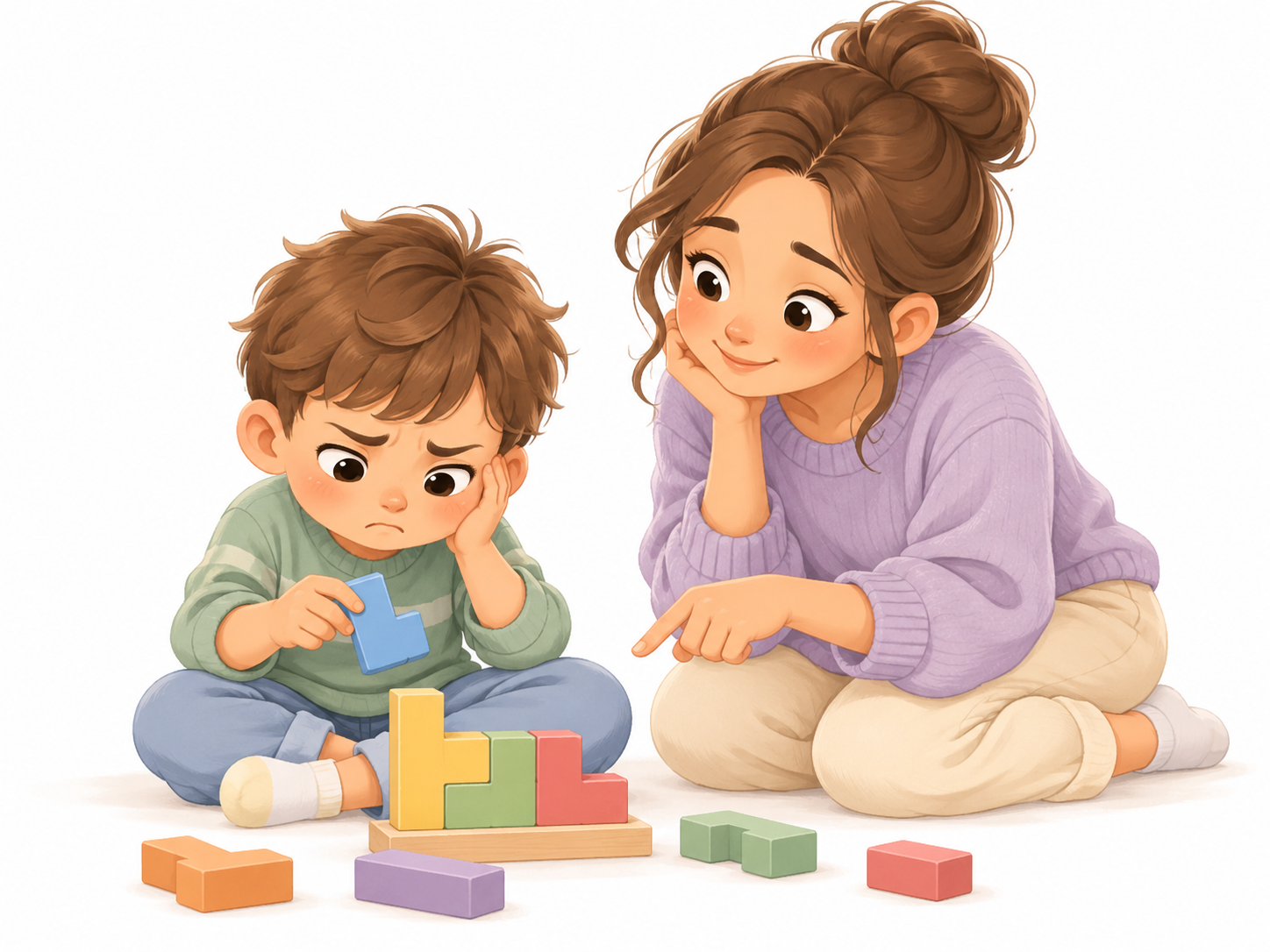
A puzzle piece won’t fit. A zipper gets stuck. A block tower falls over. Suddenly the activity is abandoned; or the child is crying, throwing the toy, or asking an adult to do it for them.
It can be tempting to step in immediately. After all, watching a child struggle is uncomfortable, and helping often solves the problem in seconds. But small, manageable moments of frustration are also where children begin learning something important: how to stay with a problem when the answer doesn’t come right away.
Frustration tolerance is a skill; not a personality trait
Some children naturally persist longer than others, but frustration tolerance also develops through experience.
Young children are still building the executive-function skills involved in impulse control, flexible thinking, planning, and emotional regulation. When something goes wrong, their first reaction may be much bigger than the problem itself.
That doesn’t mean a child is “dramatic” or “gives up too easily.” It often means the feeling of frustration is currently stronger than their ability to manage it.
The goal isn’t to remove frustration. It’s to help children experience it in doses they can handle; and discover that difficulty doesn’t always mean they have to stop.
Don’t rescue too quickly
Imagine a child trying to put on a shoe.
They struggle for a few seconds and say, “You do it.”
Instead of immediately taking over, try offering the smallest amount of help needed:
“The heel is getting stuck. Pull the back while you push your foot in.”
If that still feels too hard, help with one part and let the child finish the rest.
This is sometimes called scaffolding: providing enough support for a child to succeed without doing the entire task for them.
Over time, that support can gradually decrease.
Notice effort before success
Children quickly learn what adults pay attention to.
If all the excitement comes after completing the puzzle, tying the shoe, or building the tower, the final result can begin to feel like the only part that matters.
Instead, notice what happened during the process:
“That piece didn’t fit, and you tried turning it another way.”
“Your tower fell and you started again.”
“You were getting frustrated, but you took a break and came back.”
This type of feedback helps children recognize persistence, problem-solving, and recovery; not just success.
Let “I can’t” become “I can’t yet”
When a child says, “I can’t do it,” adults often respond with “Yes, you can!”
That’s encouraging, but sometimes it doesn’t match how the child actually feels.
A more useful response may be:
“You can’t do it yet. This part is still hard.”
That one word—yet—leaves room for learning without pretending the task is easy.
You can also help break the problem into smaller steps:
“Which part can you do by yourself?”
“Do you want a hint or a little help?”
“Let’s try one more way.”
Breaks are not the same as giving up
Persistence doesn’t mean forcing a child to keep trying while they are overwhelmed.
Once frustration becomes too intense, learning usually becomes harder. A short break can be part of problem-solving:
“Your body looks really frustrated. Let’s leave it for a minute and come back.”
Returning later teaches an important lesson too: a difficult task can be paused without being abandoned forever.
Be careful about making everything easier
It’s natural to want children to feel successful. But if adults consistently fix the puzzle, rebuild the tower, answer every question, or step in before a child has had time to think, children lose opportunities to practice working through difficulty.
The challenge should still be developmentally appropriate. A task that is far beyond a child’s ability creates discouragement, not resilience.
The sweet spot is something that is hard enough to require effort but possible with a little support.
Children don’t need everything to feel easy
Confidence doesn’t only come from succeeding.
It also comes from discovering:
This was hard. I got frustrated. I tried something different. I asked for help. And eventually, I figured out more than I could before.
That experience is far more powerful than being told “You can do anything.”
Children build resilience not by avoiding frustration, but by repeatedly learning that frustration is something they can move through.