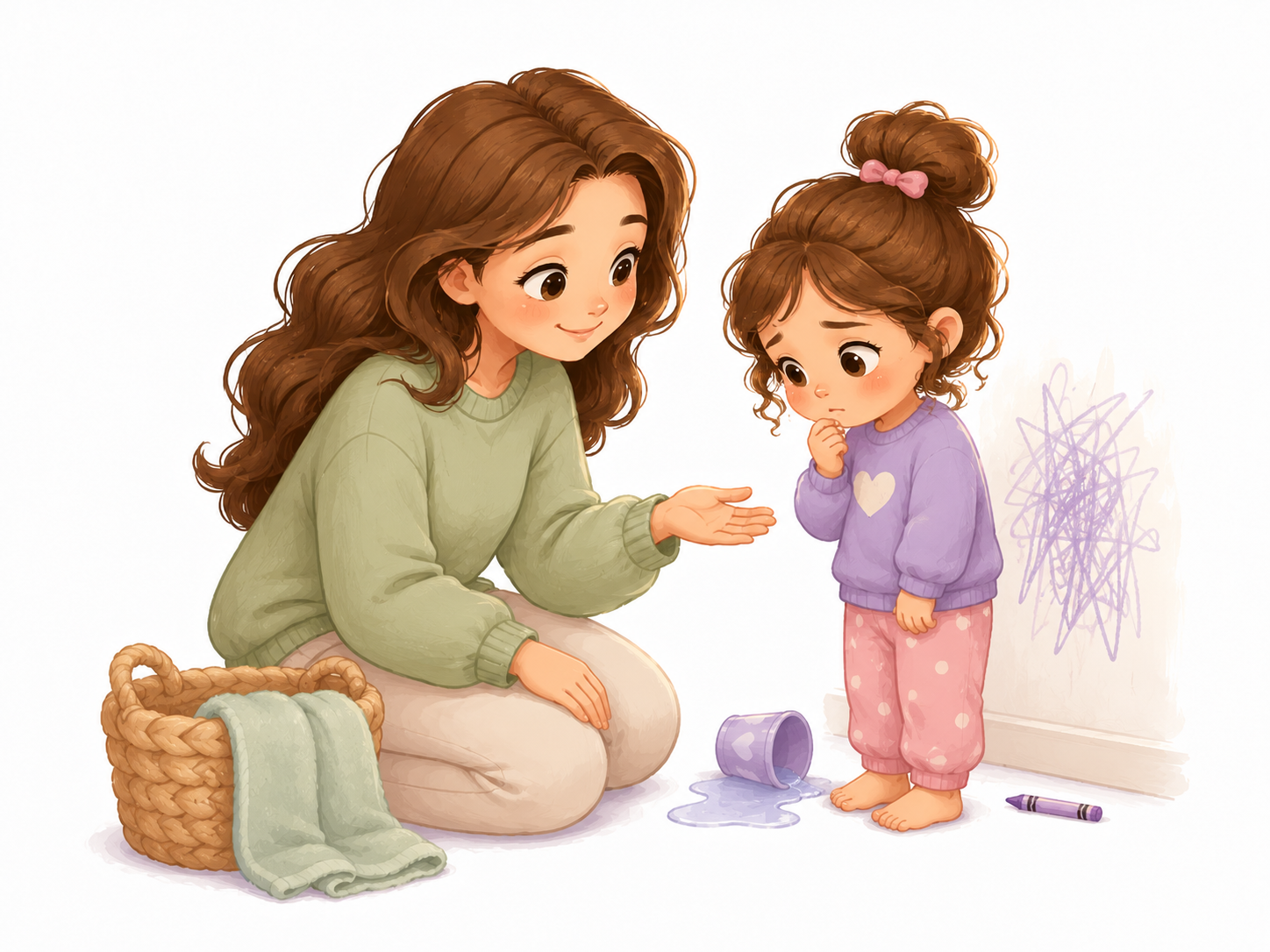
A preschooler stands beside a wall covered in crayon and says, “I didn’t do it.” Another child insists they already washed their hands when they clearly haven’t. In moments like these, parents may worry that dishonesty is becoming a habit.
But young children do not always understand truth and lying in the same way adults do. Imagination, wishful thinking, developing memory, fear of consequences, and the desire to please adults can all shape what a child says. The goal, especially in the early years, is not simply to “catch” a child in a lie. It is to gradually teach that telling the truth is safe, important, and something the family values.
Start by making honesty safer than hiding the mistake
When children expect a big reaction, they have a strong reason to avoid admitting what happened.
Imagine a child spills juice and immediately hears, “Who did this? Tell me the truth right now!” The child may already know the adult is upset. Saying “Not me” can become an attempt to avoid the emotional intensity of the moment.
A calmer approach gives honesty more room:
“I see juice on the floor. Let’s get a towel and clean it up.”
If the child admits what happened, that is a useful moment to reinforce honesty:
“Thank you for telling me. Spills happen. Let’s fix it together.”
The consequence can still remain. A child who drew on the wall can help clean it. Telling the truth does not need to erase responsibility; but it also should not make the situation dramatically worse.
Avoid asking questions when you already know the answer
Adults sometimes unintentionally create a test:
“Did you take the cookie?”
when the child is standing there with chocolate on their face.
For a young child, that question can feel less like an invitation to be honest and more like an opportunity to escape trouble.
Instead, describe what you know:
“I see that you took a cookie before dinner. Cookies are for after dinner.”
This keeps the focus on the behavior and the boundary rather than turning the interaction into an interrogation.
Remember that imagination and dishonesty are not always the same thing
Preschoolers often move easily between reality and imagination.
A child may tell you that a dinosaur broke the lamp or that they flew to the moon at school. Sometimes this is obvious pretend play. Other times, fantasy becomes mixed with something that actually happened.
Rather than immediately labeling the child as “lying,” parents can gently separate imagination from reality:
“That sounds like a fun pretend story. Now tell me what really happened with the lamp.”
This helps children learn an important distinction without shaming creativity.
Focus on the skill you want to build
Calling a child a “liar” turns one behavior into an identity.
Instead, talk about honesty as a skill and a family expectation:
“In our family, we tell the truth even when we make a mistake.”
And then show what that looks like in everyday life. Children notice when adults correct themselves:
“I told you we were leaving at five, but I was wrong. It’s actually six.”
They also notice whether adults hide mistakes or take responsibility for them.
Honesty is learned not only through rules, but through repeated experiences of seeing what adults do when the truth is uncomfortable.
Teach what to say after a mistake
Sometimes children know they did something wrong but simply do not know how to begin admitting it.
Giving them language can help:
“You can say, ‘I did it by accident.’”
“You can tell me, ‘I was scared you’d be mad.’”
“You can say, ‘I made a mistake and I need help.’”
These phrases give children another option besides denial.
Over time, the goal is for a child to learn: I can tell the truth, deal with what happened, and still be safe in this relationship.
Honesty grows in relationships where mistakes can be handled
Children need boundaries, but they also need to know that making a mistake will not threaten their connection with a parent.
The long-term goal is bigger than getting a confession about a broken toy or a stolen cookie. It is helping a child develop enough trust and responsibility to tell the truth even when the truth is uncomfortable.
Children are more likely to practice honesty when they learn that the truth leads to problem-solving; not fear.